PROLOGUE
Bust in the Dust
On a Saturday night in July, in a town most people couldn't
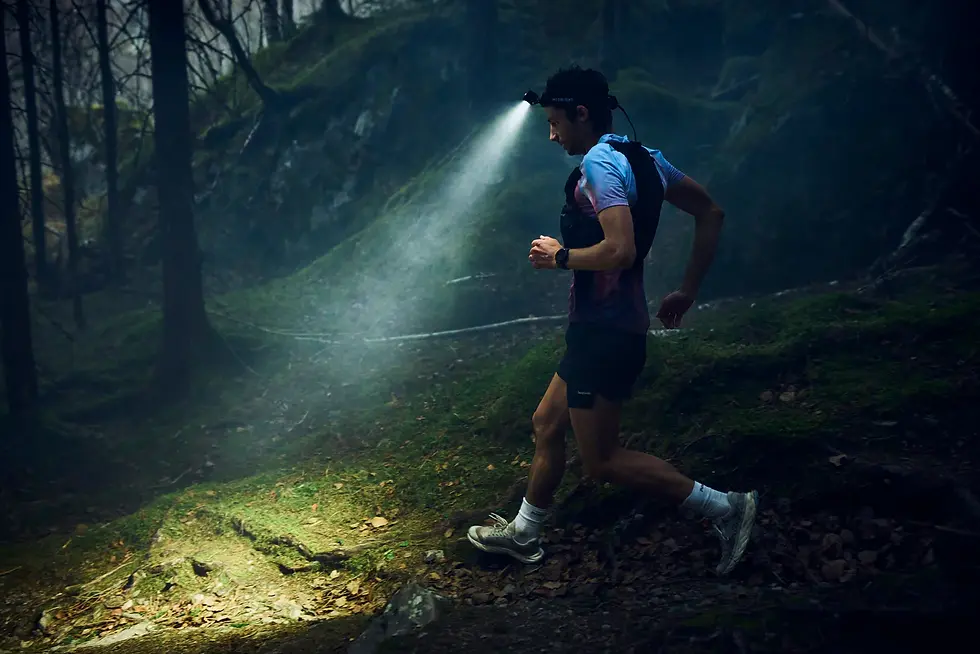
find on a map, a little under two hundred runners stood
stamping their feet in the cold, waiting to begin a race that
would take the fastest of them the better part of four days.
The course ran the width of Switzerland end to end, up and
over the vertical equivalent of several Everests stacked on
each other. To stand on that start line at all marked you as a
particular kind of person — lean to the edge of austerity, past
forty, successful enough at something else in life to have
nothing left to prove, and needing, badly, to prove something
anyway.
One of them was a man I'm going to call Sebastian. I
wasn't there. I've put that night back together from the race
record and from people who were, and where I find myself
guessing at what was happening inside him — which I'll do
often in this book, because the inside of Sebastian was the
one country he never let anyone visit — I'll tell you that's
what I'm doing.
He finished in under a hundred hours, in the top tenth of
the field, and then he did the thing that, if you knew him, told
you everything. He didn't stay. No finish-line photograph. No
foil blanket, no plate of pasta, no medal worn down to the
9car. By the time the runners behind him were still weeping
their way across the line, he was already gone.
Here is the part I can't source, so take it as mine: I think
those hundred hours had been the most peaceful of his year.
On the trail there was only ever the next step, and the one af-
ter it, and the body's slow argument with itself about whether
to continue. Off the trail, a weather system was closing on
him from three continents at once — money that needed to
move and couldn't move cleanly, partners who were not real-
ly partners, a phone that lit up, more and more, with Irish
voices. The race wasn't an escape from his life. It was the
closest thing to rest his life still contained.
Five months later, on a warm evening two days after
Christmas, a four-wheel drive moved through the centre of
Perth, Western Australia, carrying Sebastian, a second man,
and — in the back, pressed into bricks about the size and
weight of paperbacks — a little under two hundred kilograms
of cocaine.
I wasn't there for that either. But this scene the world
helped me with: there is a charge sheet, there are the things
the police carried out of a hotel room afterward, and there
were two months of surveillance logged before that evening,
which means the officers already knew the car, the men, the
cargo, and the fact that neither man was armed. It was high
summer and still bright — late December in Perth, the sun
doesn't quit until after seven — so whatever happened, hap-
pened in plain daylight, on a normal street, at the hour ordi-
nary people were deciding where to have dinner.
What the record shows is small and procedural. A car. A
signal. Sirens that did not seem to surprise the driver so much
10as confirm something he'd been waiting for. A phone that Se-
bastian used, in the last unwatched seconds, to send a loca-
tion and a single word to a number he'd been given for exact-
ly this — and then a hand reaching through broken glass to
take the phone out of his.
What the record does not show, and what I've come to be-
lieve, is that he was not afraid. I think a man who had spent a
hundred hours alone on a mountain, eating his own body for
fuel, did not have much fear left over for two police officers
on a quiet street. He had spent twenty years making himself
the most dangerous person in any room he walked into. It
took two constables on foot, who had been watching him for
two months, about four minutes.
The rest of this book is my attempt to answer a question
I've been turning over since the night I heard he'd been ar-
rested — the same question his teachers asked, and his step-
father, and the few people who ever got close enough to love
him: how does a boy from one of the safest, richest corners
of Europe end up in the back of that car?
For a long time I told myself the answer was that there
were two of him. The disciplined one, who could run across a
country without stopping. And the reckless one, who would
take everything that discipline had built and throw it into the
sea.
I don't believe that anymore. What I believe now took me
twenty years to see and this whole book to earn, so I won't
hand it over on page one. I'll say only this much: the answer
is simple. He would have hated how simple it is.